Showing posts with label China Entertainment. Show all posts

Monday, December 3, 2018

SCMP Article: Hong Kong film: from ‘Hollywood of East’ to China’s supporting cast?

After months of not posting anything (mainly because I've been super busy and haven't had time), I am finally back with an article I came across in my reading today that I wanted to share with you all.  I like this article because it provides keen insight into how the Hong Kong entertainment industry has evolved over the years and the impact that Mainland China has had on that evolution (or "de-evolution" depending on which way you look at it).  This article is lengthier than most of the other articles that SCMP puts out, but not long to the point of being a tedious read, as the amount of detail is sufficient to get the main points across.  I especially recommend this article to those who may not be familiar with the HK entertainment industry back in its glory days (the late 1970s, entire 1980s, and early 1990s), as the historical context gives a good glimpse into the past and also puts the current state of the industry into perspective.

Note that I only included the text of the article in this post, as I always have problems trying to get pictures to come out right when I do these blog posts via mobile.  Therefore, I highly recommend just going to SCMP's website and reading the article there so you can see the pictures that originally accompanied the article (there's a video clip too!).  The link is included above (in the "Source" section).

Hope you enjoy this one (I sure did…but then again, with the deplorable state of the industry currently, I've been in a nostalgic mood for a while now so articles like this – as long as they are done right – are usually nice reads for me).  Feel free to post your thoughts about the article below!

** Sidenote:  My apologies for not keeping up with this blog!  It's been a rough few months for me from a time management perspective and in weighing my priorities, unfortunately some things had to give.  With all that said, I'm not sure when I will next have time to post, but most likely I'll try to squeeze one more post in before the end of the year (I may do one about the TVB Anniversary Awards – depends on whether they piss me off enough to make me want to hop on my blog and rant about it until it's out of my system, lol).

*********

Article published November 30, 2018

Hong Kong film: from 'Hollywood of East' to China's supporting cast?

Source: SCMP

The past 40 years of reform and opening up in China have not only been about massive investments, infrastructure projects and turning the country into the world's second largest economy. The years of the Cultural Revolution left mainlanders with little to watch on television and at the movies other than propaganda. As China opened up, Hong Kong television dramas and movies offered a glimpse of the outside world, city life and of what China's big changes might bring.

When the mainland was ready to grow its own television and movie industry, Hong Kong producers and filmmakers played a crucial role, but the tables soon turned on the "Hollywood of the East". 

Today, mainland Chinese television serials and movies are immensely popular in Hong Kong, and dominate in terms of output, viewership, and box office receipts.

On a single Sunday in August this year, an episode of mainland Chinese television hit The Story of Yanxi Palace clocked up 530 million views online, setting a record.

Packed with drama, betrayal and intrigue, the 70-episode period drama won over audiences not only on the mainland, but also in Hong Kong, where it is 2018's most popular drama aired by Television Broadcasts Limited (TVB), the city's largest television broadcaster.

Costing 300 million yuan (HK$338 million) to produce, the series is about a maid who goes to work in the imperial palace to investigate her sister's death and ends up a concubine of Emperor Qianlong.

Its huge success epitomises a major shift in the television and moviemaking scene over the past 40 years of China's economic reforms and opening up.

Where mainland audiences once lapped up made-in-Hong Kong serials and movies, mainland productions now dominate in output, box office takings and viewership, including online.

There is occasional tension and controversy over red lines – political taboos and censorship – as the mainland government has become more assertive.

And where once the themes and plots were scrutinised, today the political beliefs and public actions of artists can become the issue, and some are made to pay the price.

For the Hong Kong entertainment industry, the big question is whether future success lies in integrating with the mainland, or staying distinct.

Recalling the glory days, Hong Kong cinema veteran Tenky Tin Kai-man said: "We were the Hollywood of the East. A large number of talented individuals gathered in such a small place, competing with the finest, and selling to markets across Asia."

The actor and producer, who heads the Federation of Hong Kong Filmmakers, was a teenager when he joined the industry in 1979. Now 56, he said he felt lucky to have been part of the golden era of the 1980s and early 1990s.

Between 1979 and 1999, Hong Kong made an average of 133 movies annually, peaking at 200 a year in 1992 and 1993. Meanwhile on the mainland, fewer than 100 movies were made each year in the 1980s and the cinema industry even declined in the 1990s when television prevailed.

Dr Lo Wai-luk, a Baptist University associate professor specialising in the history of Chinese cinema, recalled that in 1983, the Jet Li martial arts movie The Shaolin Temple was watched by 50 million people on the mainland.

It was one of the few distributed widely in mainland cinemas in the 1980s because it was produced by state-funded Chung Yuen Motion Picture.

Many other Hong Kong titles by independent companies such as Cinema City and Golden Harvest, including those starring comedian Stephen Chow Sing-chi, circulated by videotape.

"Can you imagine people in Xinjiang gathering to watch a Stephen Chow movie by playing a shared tape?" Lo said.

Hong Kong movies had an appeal because of the mainland's restrictions on the themes, plots and characters in movies made there.

Tin said: "Hong Kong could produce plots that mainland producers dared not make, for example, about cops committing crimes and officials being under fire."

By the mid 1970s, the city's three television stations were churning out drama series more than 100 episodes long, whereas on the mainland, the Cultural Revolution had not yet ended and it was still years before the earliest television series would be produced.

Through the 1980s and the 1990s, a wave of dramas from Hong Kong swept across the mainland.

Actress and emcee Liza Wang Ming-chun, a Hong Kong television veteran of more than 50 years, remembered being invited to Guangzhou for her first live stage show there in 1979.

"There weren't many private cars. The bridge across the Pearl River was full of bicycles during rush hour. And the people there were dressed in black, white, grey and blue – very modest in general," said Wang, now 71.

"I could see their envy as they stared at us, the stars from Hong Kong."

Rediffusion Television's The Legendary Fok was the first Hong Kong drama imported and shown on the mainland, in 1983, two years after it was aired locally.

The hero, patriotic martial arts master Fok Yuen-kap, or Huo Yuanjia in Mandarin, was so popular that the 20-episode series was eventually broadcast across the country and even at prime time by state broadcaster CCTV.

Drama serials adapted from the martial arts novels of the late Louis Cha Leung-yung followed, including The Legend of the Condor Heroes and The Duke of Mount Deer. Stars such as Felix Wong Yat-wah, Barbara Yung Mei-ling, Michael Miu Kiu-wai, Tony Leung Chiu-wai and Andy Lau Tak-wah soon became household names on the mainland.

A defining moment for the popularity of Hong Kong productions arrived with The Bund, starring superstar Chow Yun-fat and former beauty queen Angie Chiu Nga-chi in a sprawling tragic romance that has been dubbed "The Godfather of the East". Its Cantonese theme song remains popular to this day among the mainland's Mandarin-speaking audience.

"Hong Kong stood for novelty, affluence, fashion and opportunities for mainland audiences coming  out of decades of isolation," said Zhu Ying, a Chinese television culture studies professor at Baptist University's film academy.

"Hong Kong dramas provided a window for mainland audiences to peek at the outside world."

Lo said Hong Kong movies made in the 1980s by a new wave of independent production companies and featuring more outdoor, real-life locations, had the same impact.

"Audiences on the mainland now could really see the city – for example, the shopping mall in Taikoo Shing where Jackie Chan was chasing after thieves in The Police Story series – as well as modern transport, the urban way of dressing, and business situations such as board meetings," Lo said.

All these images of Hong Kong city life gave mainland film-goers, long fed anticapitalist propaganda, a glimpse of things to come in China. The "capitalist poison" label previously stuck on these movies was gradually removed.

"People on the mainland realised that outside the mainland there was a place with its own cultural system called Hong Kong, where they could find things not available at home," Lo said.

But then the mainland began encouraging its own television and movie industry, and Hong Kong helped by supplying capital, professionals and know-how.

Wang said: "We made really big contributions to the mainland at the early stage of the reform and opening up process, bringing them techniques, art directors, machines, operational models and professional crews, because we knew much more than them.

"They didn't stop at purchasing copyright. They would hire the whole team behind a programme to run the show till they grasped every bit of the craft."


'Economic power confers cultural status'

The reversal of fortunes started in the 1990s, when new television stations mushroomed on the mainland, programme production boomed, and the country welcomed private and overseas capital for joint productions.

Mainland audiences soon had much more choice. There were still programmes about the Communist Party's revolutionary history and ancient literary classics, but popular new shows such as The Aspiration and A Native of Beijing in New York showcased themes of migration and entrepreneurship.

Perhaps the last major Hong Kong drama serial to be a hit on the mainland was War And Beauty, a 30-episode TVB period production about four warring concubines of Emperor Jiaqing in the Qing dynasty.

The 2004 series was aired on the mainland two years later and is believed to have inspired a hugely popular new wave of period productions about palace intrigue and infighting.

In 2011, there were at least eight such series made on the mainland, including the 76-episode Empresses in the Palace, which drew so much attention that Hong Kong's Cable TV picked it up to broadcast in 2012.

By 2007, mainland China had become the world's largest producer of drama serials, cranking out 15,000 episodes every year.

Output was so massive that traditional television channels could not keep up, and by 2013, the internet had become a major platform. The following year 250 series with a total of 2,918 episodes were made by or for online streaming portals.

Over in Hong Kong today, all three free-to-air broadcasters are relying increasingly on dramas imported from the mainland and South Korea.

"Things have changed now that the mainland has acquired its own level of chic and fashion and technique in producing its own sophisticated dramas," said Zhu of Baptist University. "The mainland has aggressively rebranded itself as the new land of opportunity. Economic power confers cultural  status."

Over the past decade, a number of popular mainland dramas have been directed or co-directed by Hong Kong directors.

"The mainland has a lot of space, talent and capital," Liza Wang said, pointing out that the sprawling Hengdian studio complex in Zhejiang province had full-size replicas of ancient palaces for period dramas, something space-starved Hong Kong could not provide.

The mainland pays better too. "Some artists can earn several hundred thousand yuan by singing a few songs. This is unimaginable in Hong Kong," Wang added.


Walking the tightrope of censorship

The Hong Kong movie industry has noted the talent drain, Tin said.

"The mainland market has yet to reach its peak," he said, adding that the big money was not only for stars but also backstage crews, with strong support for the cultural industry from local governments.

Last year the mainland's total box office takings reached a record of 55.9 billion yuan, almost 3.5 times that in Hong Kong.

But access to the mainland market has been difficult for Hong Kong productions, because China sets a quota of 64 to 74 imported movies per year.

However, joint productions offer the city's moviemakers a way in. An agreement treats movies co-produced by companies from the two sides as domestic productions and gives Hong Kong producers 35 per cent of ticket revenue, instead of just 15 per cent. The agreement was part of the Closer Economic Partnership Arrangement (CEPA) signed between the mainland Chinese and Hong Kong governments in October 2003 to boost the city's economy, when it was struggling to recover from a downturn following the Sars epidemic that year.

Over the past 15 years, the proportion of joint productions leapt from about 15 per cent to over 60 per cent of all Hong Kong output. Three of the top 10 movie blockbusters on the mainland were joint productions, which earned between 2.44 billion yuan and 3.65 billion yuan.

But the issues of taboo subjects and censorship remain.

"Red lines have always existed," Tin said. "We don't know where they exactly are, or when and against whom they will be used.

He said many movies had not managed to clear mainland censors over the years, and there was nothing anyone could do about it.

The result, he said, was that some Hong Kong producers adopted self-censorship, while others planted a few scenes they hoped the nitpicking censors would snip quickly and clear the rest of the movie.

When the authorities are displeased, their wrath is plain.

Taiwanese artists who openly supported students taking part in the "sunflower movement" protests against a services trade deal with the mainland in 2014 were severely criticised by state-owned media on the mainland as "smashing the rice pot they eat from".

Punishment may range from a torrent of online bashing, to having contracts cancelled, a heavy reduction of screen time, or outright bans on performing on the mainland.

Singer-songwriter Anpu, award-winning director Wei Te-sheng, television host Kevin Tsai Kang-yung, and actor Leon Dai Li-jen have all paid a price.

Several Hong Kong artists met the same fate for supporting civil disobedience protesters in the Occupy movement, which shut down several business areas for 79 days in 2014.

They included singers Anthony Wong Yiu-ming and Denise Ho Wan-sze, who participated in the protests, and actors Chapman To Man-chat and Anthony Wong Chau-sang, who defended the demonstrators and criticised authorities.


Hong Kong film with Chinese characteristics?

Hong Kong comedian Wong Cho-lam, who has been active on the mainland since 2010 and set up his own studio there two years ago, said: "Nowadays contracts stipulate that if an artist or director causes damage to the production as a result of personal ethics, a criminal offence or political stance, the person will be liable."

Wong, who sits on the political advisory body to the Guangxi government, was frank about pressure on cross-border artists.

"Some Hongkongers might put me under fire when I say I am a patriot, but if I refrain from saying so, some patriotic audiences might put me under fire," he said.

Wong said he did not believe in joint productions as a way to keep Hong Kong's movie industry thriving.

"I would rather make a movie either catering to the mainland, or in the Hong Kong style," he said. "Why don't we make something with a genuine taste and character of Hong Kong and introduce it to the mainland audience?"

Lo of Baptist University did not think joint productions would destroy the flavour of Hong Kong movies.

"Project Gutenberg was loved by mainland audiences," Lo said, referring to a film released in October.

Made with investments and stars from Hong Kong and the mainland, the movie had Hong Kong scriptwriting and directing. Lo did not think the story about a frustrated painter who becomes a master banknote counterfeiter could have come out of the mainland or Taiwan.

"Hong Kong movies must find their own ethos," Lo said. "Hong Kong movies do not have to seek distribution on the mainland if they can manage the budget and attract local audiences."

Tin thought Hong Kong artists should continue working to remove the negative labels on their peers who have run foul of mainland authorities.

"To isolate or ground someone who is found politically incorrect will cause a chilling effect, which is unhealthy," Tin said.

"To some extent, Hong Kong movies have lost their charm because we agreed to compromise our professional judgment and expertise."

Liza Wang believed Hong Kong's younger talent in television and movies had a land of opportunity in the "Greater Bay Area", which has close to 70 million people who understand Cantonese.

Beijing's vision is to connect Hong Kong, Macau and nine cities in Guangdong province and create an innovation and technology powerhouse to rival California's Silicon Valley.

"There are so many people there who can understand our language and enjoy our work," Wang said. 

"And the market size is not as huge as the whole mainland so it should be suitable for young talent to get some exercise."

In March, Wang, kung fu star Jackie Chan and veteran comedian Eric Tsang Chi-wai were involved in forming a committee to help Hong Kong artists make their way into the mainland.

While Wang said she respected those who held firm to their political beliefs, she also said: "If you want to tap into a certain market, you must think twice about whether you should test the rules there."


 Additional reporting by Jane Zhang


Sunday, July 20, 2014

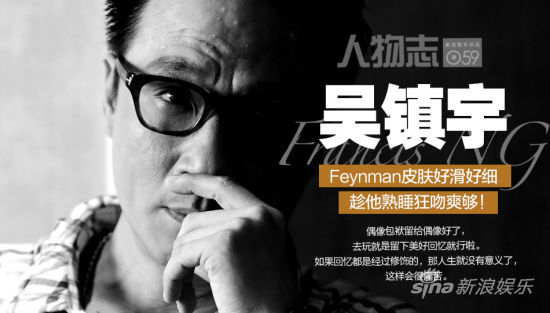
Sina Entertainment Interview – Francis Ng loves to madly kiss his son Feynman while he sleeps

Despite my busy schedule, I’ve actually been able to squeeze in quite a bit of ‘leisure’ activity lately in the form of watching TV (while multi-tasking of course…LOL).  Since there hasn’t been much to watch on the TVB front in the past few months (I’m talking about new series and programs), I’ve resorted to re-watching old Hong Kong TV series and variety programs – at the same time, I’ve also been ‘venturing out’ more by trying to watch shows from other countries (Taiwan and Mainland for example). 

Those who’ve been following entertainment news in recent months will probably remember that there was quite a bit of buzz a few months ago about a ‘high profile’ HK celebrity being invited to participate in season 2 of one of Mainland China’s most popular and highly rated reality show, Where Are We Going Dad.   Of course, we all know that HK celebrity was Chilam Cheung – supposedly, the production crew was aggressively pursuing him, offering him large sums of money to appear on the show with his son Morton.  Honestly, when I initially heard the news, my first reaction was that the deal would never go through, as I highly doubted that Chilam’s wife Anita Yuen would allow Morton to constantly be in the spotlight like that.   Well, turns out I was right (at least partially), as Chilam decided to decline the offer in the end (the ‘official’ reason was because the filming schedule would interfere with his son’s school schedule).  

Not long after that, the participants in the show were officially announced via press conference – even though we all knew that Chilam and Morton wouldn’t be on the show, many of us were surprised to learn that another ‘high profile’ HK celebrity father/son pairing would take their place instead:  Francis Ng and his 5 year old son Feynman!!

Why was it such a surprise?  Well, I don’t think I need to explain, right?  (the interview below actually does a pretty good job of explaining why).

Anyway, when I found out that Francis was going to be on the show with his son (who, up to this point, had never really been seen in public), my curiosity got the better of me and I decided I would try watching the show.  I know what people are probably thinking, so for the record – no, I’m not a Francis fan.   With that said though, Francis is an absolutely awesome actor (I grew up watching his series and later his movies and have always had a lot of respect for him as an actor) and I like him well enough as a person (his personality is quite interesting and ‘unique’)…besides, I was already planning on giving the show a try back when it was announced that they were going to try and get a HK celebrity on the show.

So basically, I started watching the show in its second season and after only 2 episodes, I was already hooked (they’ve aired up to episode 5 now) – to the point that I started reading up a bit on the show so I could find out more about it.  In fact, I also decided to go back and watch all of season 1 as well which I ended up finishing in no time.  I quite enjoyed the first season and so far, the second season has been good as well (though I already see some differences between the two seasons…but I will wait until the second season is done before passing judgment).

The below article is actually the written version of an interview that Francis did with Sina Entertainment.  The interview actually came out more than a week and a half ago, right before episode 4 had aired (that was the episode where Feynman fell into the water).  There have actually been a few articles about Francis that have come out in the weeks since Where Are We Going Dad 2 started airing – so far, the below is the most in-depth one I’ve read.  Not only that, it’s also the one that reflects the most closely with Francis’ personality (the way he answers some of the questions is totally him…haha), probably because this one is basically a transcription of an actual sit-down interview with him versus some of the other articles were just ‘paraphrased’ summaries, mostly from tabloid publications.

In any case, this interview was definitely an interesting read for me and overall serves as a pretty good ‘supplemental piece’ to the show.  For those who are currently watching the show, I recommend not only reading the text version of this interview, but also watching the 3 minute excerpt of it on Sina’s website (for those who understand Mandarin – well, HK style Mandarin that is, since Francis speaks Mandarin with a heavy Cantonese accent…LOL -- there is actually ‘bonus footage’ in the video version, as there were some questions asked there that weren’t in the text/written version – for instance, the 24 million dollar question that everyone seems to be asking as of late:  What is Feynman’s Chinese name?).  There’s also a longer 7 minute excerpt that has a lot more questions not part of the text version (here’s the link to the video for those interested:  http://ent.sina.com.cn/z/v/2014-07-08/17144171749.shtml)

One last note:  as with all interviews where there is a video and written version, there will always be some differences in interpretation of what was actually said between the 2 versions, especially since it’s harder to relay the same emotion on paper.  My translation was based purely on the text version of the interview so there will probably be a few questions/answers that don’t match up exactly to the video version.  I tried to get it as close as possible though….

**Bonus....

Lastly – here’s a mini-documentary that the production crew of Where Are We Going Dad 2 put together – each of the fathers and their kids are featured in one of the episodes.   The point of the video is to show how the fathers and their kids interact outside of the show.   The one below focuses on Francis and Feynman -- the crew actually went to HK to ‘follow’ Francis and Feynman around for a day to see how they interact.  I chose to include this video because it actually complements the below interview perfectly, as it shows just how much of a ‘big kid’ Francis truly is!  (Here's the link: http://www.hunantv.com/v/1/52884/f/704200.html)


*********************

Sina Entertainment Interview – Francis Ng loves to madly kiss his son Feynman while he sleeps


Article originally published 7/8/2014

Translation:  llwy12


Anthony Wong (黃秋生) once assessed his good friend Francis Ng (吳鎮宇) in this manner:  “He is truly ‘Wong Yeuk Si (黃藥師)’ [the character from Jin Yong’s novel Legend of the Condor Heroes] – every move he makes is strange , odd, mysterious…you never know what his next move will be!”

Recently, Francis Ng demonstrated one of those ‘strange’ moves!   Personality-wise, Francis is known for being proudly aloof and socially awkward, dislikes conforming to society’s norms, and absolutely loathes constant public exposure– yet ironically, he chooses to participate in a wildly popular TV program that publicly ‘exposes’ him to millions of television viewers every week:  the second season of Mainland China’s highly rated reality show Where Are We Going, Dad? (爸爸去哪儿).  Not only that…even more ‘strange’ is the fact that Francis -- who has always been extremely low key when it comes to his family and tries to fiercely protect his son Feynman Ng from the prying eyes of the Media as much as possible -- decided to take everyone by surprise and put his son into the spotlight as well by participating in the program with him.

In preparation for this interview, our reporter had diligently reviewed many of Francis’ past interviews with various media outlets, hoping to understand what to expect when Francis walks in the door.  Of course, the result is unexpected:   Francis saunters carefreely into the room, carrying a small bag on his back, holding a water cup, wearing framed glasses that complemented his casual, playful look.  According to the Where Are We Going, Dad 2 production crew, that’s how Francis is like in real life – basically, he’s a big kid at heart.

Given his personality, many people were interested in knowing how Francis approached filming for the program.  Towards this, Francis expressed that the key was finding self-amusement:  “I don’t have a tremendous amount of social interaction with the other dads and I’m definitely not the type to make small talk about nothing just to be polite – to me, that’s too fake.  Don’t give me a script either and ask me to conform to it – as long as I know the rules of the game and play by them, then I can have fun with the rest of it.”   Francis describes his filming experience for the program similar to going back in time to the ‘primitive’ era where everyone has to rely on their natural, basic instincts to survive.

During the interview, Francis would become particularly animated and excited whenever the subject of his son Feynman came up.  He describes his son as having an ‘artist’s temper’ who often did things that were ‘out of the ordinary’ – and would then proceed to imitate his son’s ‘out of the ordinary’ gestures or describe an ‘out of the ordinary’ thing that his son did.   As the conversation went on, it became apparent that Francis wasn’t just describing his son -- he was also describing himself.  In that sense, Feynman wasn’t just Francis’ son – in inheriting his same ‘mysterious’ characteristics and qualities, Feynman was also his ‘soulmate’ and an extension of his own self.

While he enjoys the ‘playful’ and ‘active’ side of Feynman, Francis expressed that he loves his son’s ‘peaceful’ side the most.  Francis describes Feynman as having very ‘delicate’ and ‘pretty’ features as well as a smooth complexion that would make females jealous.   This is something that makes Francis especially satisfied and content -- whenever he sees Feynman sleeping peacefully in his bed, he can’t help ‘madly’ kissing his son, to the point that Feynman, amidst his deep slumber, would unconsciously lift up his hand to cover his mouth and face.  Once he has kissed his son enough, Francis happily and contentedly goes to sleep himself.   While describing his feverish love for his son, Francis continued to repeatedly praise his son’s pretty features and smooth complexion – at that moment, it seemed as though a completely different Francis Ng was standing in front of us, showing a side of himself that most of us are not used to seeing.

It’s no secret that Francis has a ‘unique’ way of looking at things and dealing with matters that many of us would find ‘odd’ or ‘strange’.   At first glance, his viewpoint may seem weird and hard to understand, but upon deeper thought and reflection, we start to realize that his opinions are actually in-line with his philosophy on life – that is, to maintain somewhat of a crafty, mischievous relationship with the world and its surroundings.  With life being so heavy and challenging at times, why not loosen the ties first and learn to take things less seriously?    

For this interview, we put together a few tough, ‘out of the ordinary’ questions for Francis to answer, through which we can pretty much sum up this ‘unconventional’ father’s value system this way:  “Always be yourself and don’t be concerned whether others are able to put up with you or not.”

.----.

SR = Sina Reporter
FN = Francis Ng


SR:  A lot of people call you ‘three year old Ng’ – is that how old you feel you are mentally?

FN:  I actually taught them [the fans] that nickname.  When some people worship idols, they lose all sense of reason and sometimes they end up acting foolishly – I’m actually not too fond of people like that, as I believe those people must not be too smart to begin with to act in such a way.  But then I realize sometimes there are moments when even I put my wisdom aside in order to ‘chase’ an idol– like last time for example when I met Yao Ming (姚明) and yelled out in excitement, just like kids do when they see their idols.

SR: How did your ‘three year old Ng’ nickname come about?

FN:  Awhile back ago, every time my father-in-law saw me, he would tell my wife:   “Your husband is quite interesting – even though he is already 40-something [years old], he doesn’t look his age at all.  From the back, watching him when he walks, he looks like a 20 – 30 year old and when he turns around, he looks even younger.  And as soon as he opens his mouth, you can tell that he is only a kid – someone with an intellect of a 3 year old!”   That’s my father-in-law’s opinion of me.

SR:  How about your wife?  Does she act ‘3 years old’ toward you at times?  Are you her idol?

FN:  She’s stronger than me when it comes to getting along with people – she has good social skills and can quickly become friends with people.  She’s also more direct and takes the initiative to make friends.  In other areas, I’m like a father watching over her [and Feynman] – for instance, the weather in Singapore where they used to live is very hot, since it’s always summer there, but here in Hong Kong, the weather can vary greatly from hot to cold…I often have to remind her to adjust accordingly.

SR:  Are you an attentive, considerate husband?

FN:  No.  Actually, I dislike doing that kind of stuff, it takes too much time.

SR:  So your personality complements your wife’s then?  She’s more outgoing and you’re more reserved.

FN:  No, not really ‘complement’.  From a relationship standpoint, I feel that it’s better for us to manage our personalities on our separate ‘platforms’ – her platform is taking care of our home and our son while mine is my work.  She doesn’t step onto my platform and I don’t step onto hers.  If there’s a difference of opinion in an area that she’s responsible for, she gets to make the final decision and I don’t intervene– it’s very simple.  But then when it comes to my work, she doesn’t interfere either or insert any opinions.

SR:  The other dads on the show all call their wives at night to update status, but you’re the only one who doesn’t.

FN:  Why don’t you guys look at it from the perspective that maybe they’re afraid their wives will worry, so they feel they need to report status every night?  Or perhaps they had a bad record in the past so they feel they’re better off giving their wives updates?  (laughs)

SR:  Once the other dads hear you say this, what do you think they’ll say the next time they see you?

FN:  They will say: “How did you know?!” (laughs).   I actually do call as well, but there usually isn’t anything to talk about.   Feynman likes to play around with the buttons on the phone and when he accidentally dials his mom’s number, he hangs up as soon as he hears her voice.   Perhaps the other kids call often because their moms didn’t accompany them over here.   My wife always accompanies Feynman up to the last leg of the trip, then Feynman and I go up to the mountains for a day or two and right when we come down, he sees his mom again.

SR:  Do you consider yourself the type of husband that your wife never has to worry about?

FN:  I feel that nowadays, none of the wives need to worry about their husbands because there is a lot of ‘public monitoring’ going on – no matter where you go, you will get photographed.  Even if you try to wear a mask, someone will still recognize you; if you want to change your skin and become a different person, you won’t even know where to go to get it done without someone seeing you.

.---.

SR:  During an interview, Feynman was asked what kind of animal you resemble and he replied “a mouse”.  When asked why, he said “because you are so small”.   What did he mean by that?

FN:  I’m not sure.  I don’t know why he said that.  A lot of times, after he says things, even he doesn’t know what he’s trying to say.  Doesn’t matter though, as long as he is happy, it’s fine.  That’s the interesting thing about Feynman – he understands how to make good use of punchlines and sometimes, when an adult asks him something, he’ll try to respond with something funny to make people laugh. 

SR:  When Feynman accidentally fell into the water, why didn’t you go to him right away?

FN:  Sometimes when people do foolish things, accidents happen.  People ask me why I’m so strict toward my son and I tell them:  how many times in a day am I able to help him up?  Every ten steps he walks, he trips one step – that’s how his life is…trips, gets up, trips, gets up – I have no reason to accommodate and help him up each time.   That’s why I didn’t go to him right away – I wanted him to reflect on his actions.

SR:  Is Feynman an only child?

FN:  He has a ‘twin’ sister!  [Francis once uploaded a ‘girlish’ picture of Feynman onto his Weibo with the caption “Feynman’s twin!”]

SR:  Do you like the ‘boy’ Feynman or the ‘girl’ Feynman better?

FN:  He’s a very interesting kid.  Sometimes, he truly does act like a girl, very quiet and reserved, and I feel like just holding him in my arms and hugging him close. Other times, he’s like a hooligan who misbehaves and doesn’t want to abide by the rules – that’s when the real Feynman comes out.  When he sleeps, he looks like a little girl, so sweet and peaceful, I can’t help kissing him madly, to the point that he would cover his mouth with his hand while still sleeping.   It’s almost like he has a dual purpose – sometimes when he acts like a girl, you embrace him and he leans against you, sticks to you, then the boy in him comes out and you become a bit stricter with him, discipline him.  He truly is very cute and interesting.

SR:   Your wife must find it annoying when you do that [kiss his son madly while he sleeps]?

FN:  Yes, definitely.  She doesn’t like it, but that’s okay – I just wait until she’s asleep, then I go check on my son and kiss him.  I’m actually a very light sleeper and wake up easily, so I usually wait until everyone is asleep before I go to bed.  Every night, when my son is asleep, I go over and kiss him until I’m happy and satisfied, then I go to sleep.  Isn’t that my right as his dad?   He’s truly a lot of fun, especially when he’s asleep!   His skin is also very smooth and delicate, no one can compare.

SR:  Is that why you let him grow his hair out longer?

FN:  Actually, he’s the one who likes his hair longer because it makes him look like his idol Bruce Lee.  I take him to watch Bruce Lee movies all the time.  Spiderman too….another favorite.  He’s the one who refuses to cut his hair short.  It’s actually better this way – with his ‘girlish’ side, makes it easier to dote on him.

SR:  So if he were to cut his hair short, you would be much stricter with him?

FN:  Yes, a lot stricter.

SR:  Have you ever bought him a dress?

FN:  Of course not.  Besides, he would never allow it.  That’s why I wait until he’s asleep to kiss and dote on him.  The ‘peaceful’ Feynman is truly very pretty and sweet.

SR:  In your son’s heart, are you a hero to him, like Spiderman?

FN:  I don’t know.  I guess he thinks I’m an amusing person who can sometimes be very strict.   We also goof around a lot too – like sometimes when I’m napping, he would put his feet with stinky socks on my face and keep harassing me until I wake up.  Or we would play tricks on each other…we have a lot of fun together.

.---.

SR:  How much of what we see in Where Are We Going Dad 2 is the ‘real’ you?

FN:  100% of it is the real me.   It’s true that they don’t give you a script – they only provide a rough blueprint of the activities involved.  The person who tried to ‘guide’ us on what to do no longer exists – we buried him back in Tiankeng [the first filming location for season 2]!  (laughs)

SR:  Did something like that actually happen [someone trying to ‘guide’ them]?

FN:  One time they asked me:  for the question from earlier, can you change a few words in your answer?  I told them “no – if you are going to do that, then might as well just give me a script and I’ll perform to everyone’s liking.  Like right now, I’m going against what you tell me, you should be filming this too..no need to edit it out!”

SR:  You’re actually quite popular on the show.  Did you anticipate such good results?

FN:  When a savage, an animal from the outside world suddenly sets foot in the city, of course it will attract some attention and maybe even become a topic of discussion.  It’s natural for people to be curious and excited over something they’ve never seen before.

SR:  People are so interested in you because in the past, you usually give off the image of being cool, yet distant.

FN:  That’s true, but being cool and distant helped me earn a living and make lots of money – in comparisons, this current ‘job’ [appearing on the show] doesn’t help much in terms of money. [TN:  In an interview with Mingpao last week, Francis revealed that his remuneration fee for appearing on the show is the lowest of the 5 fathers.]  However, it does give me the chance to have a crazy time with Feynman – plus there are so many people to keep us company and play with us.  Oh and of course there’s the production crew constantly thinking up interesting games for us to play and arranging different living conditions for us to experience – I see no reason not to participate.

SR:  In one of the episodes, you and the other dads had to learn to sing ‘chuanjiang haozi’ (labor songs).  What was up with that high-pitch accent you used?  You’re normally a pretty good singer, so hearing you sing in that manner was definitely a highlight of the episode! 

FN:  Actually, it’s because at the time, I was too much ‘in the moment’.  I was actually imitating that guy – what’s his name again, the guy with the white towel around his head who is always singing in a high pitched voice?  (Ah Bao?)  Yes, yes, ah Bao!  He was singing in that same accent and I thought it was quite funny, so I decided to learn it.

SR:  When it comes to appearance, you seem to have high standards and oftentimes, you take care of hair and makeup yourself.  This time around, your ‘look’ on the show is not as ‘cool’ as what people might expect.   You don’t have any ‘idol baggage’?   After all, you are a celebrity with lots of fans.

FN:  Why is there need for makeup?   The purpose of going on trips is to have fun and create beautiful memories to look back upon, not worry about how one looks.  Leave the ‘idol baggage’ to the idols!  Honestly, if memories have to be ‘dressed up’ too, then life will really become meaningless and painful!   I don’t feel that I have a whole lot of weird habits, but sometimes, people focus on the one or two unfavorable traits and can become blind to the favorable ones.   People like it when I’m overbearing or when I don’t conform to others’ expectations so they don’t pay much attention to the more personable traits.  To me, ‘idols’ are not too personable – they are hard to get close to because they want people to admire them from afar.  Actually, it’s kind of interesting that a lot of idols are ‘kids’ [TN: teen idols, for example]…why do you think that is?  Well, because up here (points to his head), they still think like kids – if they were truly mature and ‘grown up’, they would let go of that child-like thinking.  In a way, it’s kind of sad.

.---.

SR:  Have you had the chance to practice those ‘labor songs’ more with the other dads?

FN:  No.  I’m not the type who likes to chit-chat or hang out with others – why is it necessary when I’m able to keep myself amused?  Actually, self-amusement is something I’m an expert at, just like my son –we’re perfectly happy playing alone.  Like how Feynman pretends to be Spiderman, it makes him happy.  I scold him for wearing that mask all the time, especially when it’s hot outside and he can barely walk straight because he can’t see too well…..but hey, it makes him happy so in the end I just let it alone.   That’s why sometimes when you guys see that I’m stricter than usual with Feynman, it’s because at that moment, his bold, unrestrained personality went a bit overboard.

SR:  So you rarely interact with the other dads?  Always off finding amusement by yourself?

FN:  It’s better for me when a game has rules.  Otherwise, when you don’t know someone too well, it’s hard to find something to talk about.   You don’t want to be overly polite either – ‘How are you? I’m fine. Have you eaten yet? Oh, you’re participating in this show too? Me too!’ – people will think you’re being way too fake.  It’s better to be a little bit detached, distant.  If we only see each other once, then fine, be overly courteous and polite, doesn’t matter as much – but having to see each other so often, definitely not a good idea to be fake.

SR:  How do you usually interact with your close friends?

FN:  When we interact, our main goal is to ‘insult’ each other as much as possible with our ‘poisonous tongues’.   Since almost all my friends are theater actors, their speaking skills are excellent, so we always have a great time poking fun at each other …it’s very satisfying.  If I had to change the way I interact with them or if it’s people I don’t know, I wouldn’t be able to just chat like that.  I feel that for guys, this type of communication method is the best when interacting with close friends.

SR:  Do you share parenting tips and experiences with your buddy Anthony Wong?   Anthony once said that he will not let his kid spend his hard-earned money.  Do you agree with that?

FN:  Of course he won’t let his kid spend his money – he doesn’t make much money in the first place!   He doesn’t even have enough money to spend himself, since his income is so low. (laughs)

SR:  Talking about him like that, aren’t you afraid he’s going to beat you up?

FN:  Sure, he can try to beat me up, but I’ll win the fight!  (laughs).  Joking aside though…nowadays a lot of sensible kids have the ability to be independent and don’t want to use their parents’ money.  There are also a lot of millionaires who don’t leave money for their kids either.   I actually never liked spending my dad’s money – he worked hard his entire life earning the money, he should be able to spend it how he wished.  Unfortunately, I was never able to truly take care of my dad– by the time I was able to earn enough money, he had already passed away.  My mom also has never asked me for money to spend – in fact, I probably still owe her money from all the times I’ve borrowed from her!