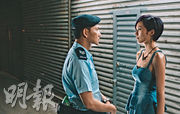
HKTV's second to last in-house produced series Night Shift will premiere on Wednesday (8/19). I've actually been looking forward to this series ever since I read about the filming of it 2 years ago! It's been a long wait, but based on everything that I've read as well as the trailer clips and other behind the scenes clips, I feel that this series will be a worthwhile watch. Of course, the sad part is that this also means we are one series closer to 'the end' of HKTV (though to be honest, it pisses me off more than saddens me, but I'll save that rant for another post). The below article came out today from Mingpao in anticipation of Night Shift's premiere -- it's a nicely written article / short interview of the creative minds behind the series: Jimmy Luk and Alex Pau (yes, that's the same team that produced To Be or Not To Be, which is one of my favorite HKTV series so far). I've also included a link to the 'documentary clip' that the writer mentioned in the article -- I actually saw the clip on HKTV's Facebook a couple days ago and posted it up on AF....here's the 'blurb' I wrote about it (paraphrase of what HKTV put on their FB post): As a prelude to next week's premiere, HKTV posted the following clip on their Facebook page. This is a special "documentary" clip that one of the professors and her student at Chinese University in HK put together documenting the last 2 weeks of filming Night Shift. According to the post, when the government made the announcement denying HKTV a license back in October 2013, Night Shift was in the middle of filming and was only 70% completed. Even after the announcement, the production team decided to finish filming anyway and this clip not only bears witness to how everyone felt at that time, it also shows the unity of the team and how much fire and passion they still had despite the imminent disbanding of the team....
The article is relatively short compared to MP's other interviews, but still a good article nonetheless. Enjoy!
Sincere. For
HKTV, that’s not a word that merely gets spoken – rather, they put that word
into action through their productions. A
television series produced with ‘sincerity’ is one that will definitely be felt
by discerning audiences.
As the second to last of HKTV’s series to air, the ‘sincerity’
of the series Night Shift (夜班) can already be felt
even prior to its broadcast. In October
2013, when the government’s decision to deny HKTV a license came down, Night
Shift was still in the middle of filming – faced with the possibility
that the series might never see the light of day, plus most of the production
team members were on the list of employees to be laid off the next day, the
group collectively decided that they still wanted to finish filming the
series. Tomorrow (8/19), two years after
it finished filming, Night Shift will finally get to face
audiences.
Earlier, there was a short 7-minute clip posted on the
Internet that documented the series’ last 2 weeks of filming. Watching the clip, the part that moved viewers
the most was when Alan Luk (陸駿光) expressed during an
interview segment that he felt the cast and crew of this series were like the
orchestral band in the movie Titanic – even during the last
moments of the ship sinking, they insisted on finishing their very last
performance. For those who participated
in the series, this was not merely a ‘project’ that they finish and move on to
the next one -- rather, for everyone involved this was a ‘work of art’ in which
they invested a lot of blood, sweat, and tears.
Three main story
arcs
Interviewed for this article, Night Shift’s chief
director Jimmy Luk (陸天華) and script supervisor
Alex Pau (鮑偉聰) revealed that the concept for the
series actually came from American TV series Third Watch, a story
about people who worked at night. The 3
main story arcs revolve around the West Kowloon district’s E.U. team (衝鋒隊)
headed by Frankie Lam (林文龍), the underworld triad
led by Philip Keung (姜皓文), and a group of young
women, led by Kathy Yuen (湯怡), who frequent seedy
night arenas in the hopes of making a quick buck. Within these 3 main arcs, there are many sub-story
arcs that involve a vendor selling fruit at his stand, a vegetable street
market, a trash collector, an ambulance, and even a ridiculous murder case that
occurs at a midnight fair. Jimmy Luk
expressed: “Each sub-story arc will take
up anywhere from ½ to 1 episode and will be interwoven throughout the 3 main
story arcs. Because of this, audiences
may feel that the plot is bit ‘scattered’, as the story will jump from one occupation
to another – this is actually done on purpose, as the main focus is really on ‘night-time’. Things that people may not be willing to say
or do during the day, all is let loose at night, people’s true sentiments are
revealed, and the dark side of society is brought out.”
Laid off workers
continue to participate in the series
Helmed by the same production team as HKTV’s earlier hit
series To Be or Not To Be (來生不做香港人), Night
Shift marks the second collaboration between director Jimmy Luk and
scriptwriter Alex Pau. Recounting that
fateful day in October 2013 when the government’s decision to deny HKTV a
free-to-air TV license came down, Jimmy Luk revealed that his boss Ricky Wong (王維基)
called him to his office and told him that he was planning on laying off 200
people the very next day. Given the
circumstances, Jimmy was asked whether he wanted to continue filming the series. As someone who believed in finishing what was
started, plus so many people had put their hearts and souls into the
production, Jimmy did not hesitate in telling Ricky Wong that he wanted to
continue filming the series -- with that, all of the workers who were already
laid off immediately returned on a ‘free-lance’ basis to finish the production.
The rare chance to work together again and
the determination to ‘finish what they started’ united the team together –
morale was especially high and the ‘fire’ in their hearts burned stronger ever. Jimmy expressed that working for HKTV was the
most enjoyable experience of his career, as he got the chance to feel what it
meant to truly have ‘complete creative freedom’, which is a concept virtually unheard
of in the HK television industry. Without
hesitation, Jimmy stated, “If one day Ricky Wong is issued a license and he
asks me to go back and work for him, I would do it in a heartbeat!”
With Night Shift being scriptwriter Alex
Pau’s very last collaboration with HKTV, he states that instead of feeling sad
at having to leave the company, he decided to approach it with a heart of
gratitude that he got the chance to explore different genres and filming methods
at HKTV. “The concept for Night
Shift came about after Ricky Wong declared that he wanted to take an ‘American
series approach’ with all of his productions.
This entirely ‘new’ style of filming was rare in the HK television
industry and through it, we hoped to show audiences that it IS possible for HK
production teams to film series this way.
Actually, I need to specially thank director Jimmy Luk – at that time,
Ricky Wong was very ambitious and upped the ante by having all the script
supervisors ‘sell’ their story concepts to the group and gave the chief
directors complete authority on whether they liked the stories enough to film. Some of the story concepts were actually rejected
by the directors, so you can imagine the pressure that us script supervisors
felt. During that presentation, when I
brought up the premise for Night Shift, Jimmy Luk was the first
one to raise his hand and say ‘I really want to film that!’ To this day, I am still extremely grateful
for his recognition!”
Filmed entirely at
night, no ‘main leads’ in the series
Alex Pau further expressed, “I would also like to thank
the artists who participated in the series – it was hard enough that they all
had to re-arrange their schedules for a month to film entirely at night, they
also had to deal with a neurotic script supervisor such as myself! This series is unique in that everyone’s screen
time is scattered and uneven and the main story line is fuzzy – to be honest,
none of the artists in the series can be considered ‘leads’. This is an entirely new format and also a
different way of storytelling that left the artists a bit perplexed when
filming, but they persevered anyway.
Lastly, I would like to thank the entire production team for selflessly giving
so much of their time and effort to help me fulfill this crazy story concept!”
-The second segment
starts with the host continuing the conversation (from part one) about how the
‘system’ at HKTV is different from TVB and that’s why the output is different
as well.
-The host said that
the day before, he had interviewed Maggie Cheung (張可頤) and asked her about her thoughts
filming TBONTB. One of the things she
mentioned was that this was the first time in her acting career that she had received
the entire script prior to filming. At
TVB, it was nearly impossible to read the entire script prior to filming – they
usually only received the script for a few episodes at a time, so it was very
hard to grasp how the character is going to develop.
-Given the topic of
‘on-the-fly’ scripts, the host asked his guests (scriptwriters Alex Pau and
Benny Wong and director KK Wong) how HKTV is able to achieve the ‘100% complete
scripts’ mandate.
oBenny Wong clarified that not every series at TVB was
‘on-the-fly’ – it really depended on which production team (some are worse than
others). In some cases, the scripts may
be close to completion, but the production team might have encountered some
‘problems’ or need to change the script for some reason, so they couldn’t
complete timely.
oBenny and Alex stated that HKTV must have complete
scripts prior to filming because Ricky Wong requires it – they are not allowed
to start filming until the script is 100% completed and distributed to the
artists.
oThe reason why they were able to meet this consistently
was 1) the station had not launched yet so there was plenty of time to write
the script, and 2) HKTV has fewer obstacles in terms of ‘timing’ (meaning that
they don’t have to ‘jump through hoops’ to get their story ideas ‘approved’
like they did at TVB).
-The host asked them
to describe what the script writing process entailed at TVB – he asserted
(somewhat sarcastically) that the ‘winning formula’ for TVB series seems to be to
write a generic story, throw in a few love triangles and/or complicated love
relationships, end with a ‘happily ever after’ barbecue scene, then
repeat. This is the ‘formula’ that TVB
has adopted for decades and audiences are so familiar with it already that it
has become a ‘culture’ of sorts.
oAlex stated that this ‘formulaic’ approach to
scriptwriting is not a ‘new’ thing – in fact, it has been in effect for many
many years. The reason TVB uses this
method is because it is easy, fast, and most efficient.
oThe reason why it is ‘fast’ and ‘efficient’ goes back to
the ‘approval’ process mentioned earlier [in part one of the interview]. If the story idea that you are trying to
‘sell’ is obscure, controversial, complicated, etc., you will have difficulty
getting buy-in from all the people who need to ‘approve’….alot of time will be
wasted trying to ‘convince’ everyone to ‘accept’ your idea. [sidenote: at this point, the host jokingly said: “well,
unless you’re producer Jonathan Chik – otherwise, you will definitely waste a
time of time arguing”]
oMost of the scriptwriters at TVB conform to the process
because: 1) it’s fast and convenient – why delay people from getting off work
on time by trying to be ‘different’ and causing issues; 2) it’s less hassle – quickly ‘sell’ the
idea, get approval/buy-in, then can start filming right away; 3) the ratings
will always be good anyway [TN: TVB’s monopoly over the HK television
industry means that their ratings will always be decent no matter what type of
series they churn out], it makes the company happy, so why not?
-The host turned to
KK Wong and asked him: for The Election,
if this were TVB, would you not even bother trying to ‘sell’ the idea, since
there would be so much opposition and it would for sure be banned?
oKK responded that at TVB, it’s best not to even mention
the word “politics”, as it’s a ‘taboo’ subject.
He said that if he were to even mention the word, his story idea wouldn’t
even get past the first stage of – it would have been ‘banned’ from the start.
[TN:
this coincides with what Alex Pau mentioned in the book he wrote about 6
or 7 years ago about his life as a scriptwriter – he listed all the topics that
are considered ‘taboo’ at TVB and they are not allowed to film… I don’t
remember all of them at the moment, but I know for sure ‘politics’ and ‘religion’
were 2 of those topics…]
oHe also expressed that after working at TVB for a long
time, the scriptwriters and producers all have a ‘self-reflection’ and ‘self-censorship’
mentality – meaning that they already know they will encounter problems if they
even try tackling a particular topic, so why waste time attempting in the first
place?
oThe other thing about the work environment at TVB that
complicates things is that they (the execs/management) are rarely forthcoming
or direct with you. For instance, if you
mention wanting to film one of the ‘taboo’ topics, they will never tell you
directly ‘no, you can’t do that’ – instead, they will ask you all sorts of
questions and make the process as difficult as possible, to the point that the
person who mentioned the idea will feel it’s too much hassle and decide to
abandon the idea on his/her own.
-Both of HKTV’s
currently airing series reflect what is going on currently in society – The Election
talks about the HK political scene while To Be or Not To Be talks about the
long-time conflict between HK and Mainland China.
-Discussion about the
series TBONTB:
oThe host asked Alex Pau whether there is special
significance to the way the opening theme video and the transitional video
during each of the break segments are designed.
Just in case people didn’t notice, during the break segments, the middle
characters of the 7 character title are ‘blurred out’ – so if you read the
non-blurred characters only, you’ll notice it says ‘come HK people’….is there a
particular meaning to this?
oAlex answered that the design of the title flow should be
credited back to the series’ main director Luk Tin Wah. He said that there is indeed a purpose behind
the design – each audience will view the title in a different way depending on
their own background and experience. For
example, you can interpret those remaining characters as a way of encouraging
HK people (‘come on, Hong Kongers’) or you can look at is not wanting to be a
Hong Konger.
oThe purpose of designing the title that way [TN: there’s also significance to the way the
artists’ names are listed in the opening credits, which wasn’t mentioned during
the interview but was explained on HKTV’s Facebook page later on] is to
make audiences think and reflect: if you
were given the choice, would you choose to be a Hong Konger? How about your children and grandchildren? Would you want them to be Hong Kongers?
oThe host asked Alex for his personal interpretation of
the title: which perspective does he see
it from? The Mainland sister’s
perspective (HKers have a certain attitude and can’t stand them), the HK sister’s
perspective (too much pressure being a HKer due to all the conflicts and would
rather not be a HKer) or the ‘future foreboding’ perspective (sooner or later,
HKers will lose their identity and no longer be HKers)??
§Alex stated that from a creativity standpoint, he can see
it from both perspectives (HK and Mainland).
He said he has a Mainland friend who once said to him: “HK is like a
spoiled child”…already treated well yet still wants more. This made him reflect and realize how true it
is that each person’s perspective will differ depending on which ‘side’ you
come from (HK side or Mainland side).
For example, some Mainlanders may think – hey, you guys (HKers) are
already given special treatment all the time, daddy already spoils you, lets
you play with all the toys and do things we can’t do, yet you still feel it’s
not enough and have to push for more?
Meanwhile, HKers see it from the opposite perspective and feel their
freedoms are being taken away.
§This helped Alex understand that growing up in different
places with different education and cultural influences will cause your mindset
to be completely different. Taking it
down to a smaller scale – even in a household, you might all be HKers, yet you
could hold drastically different perspectives on things that could cause the
household/family to be divided.
§The purpose of the title (and the series as a whole to
some extent) is to urge people to recognize that there are issues.
oTo conclude the TBONTB segment, the host asked Alex a
very interesting personal question: in
your next life, would you choose to be a Hong Konger? Alex’s response: Yes, absolutely! Why?
Because even though HK is not what it used to be and despite all the
problems going on, he was born here, grew up here, his friends and family are
here, so he feels that even if the boat is truly sinking, he will accompany to
its end.
-Next is discussion
about the series The Election:
oFirst, a fun fact – KK and Benny are actually brothers
(people may have noticed the similarity in their names). KK (the director) is the older brother and
Benny (the scriptwriter) is the younger brother.
oThe host asks Benny:
this is the first time that a TV series about politics in HK has been
made. Without prior experience with this
type of topic, how were the ‘sensitive’ portions of the series handled? Previously at TVB, you wouldn’t dare to write
this kind of stuff, so now, writing it for the first time, what was going
through your mind? Were you worried at
all?
§Benny said that when he first started writing the script,
he didn’t think much about whether the topic was ‘sensitive’ or not. He just wanted to lay out the story for
audiences and think of ways to add in the dramatic elements, since it IS a
drama series after all.
§In the middle of writing however, he (and his brother KK)
started questioning himself – is this perhaps a bit overboard? Perhaps a bit too ‘sensitive’?
§The host asked what parts were ‘sensitive’, to which the
brothers responded – the piece about the Media for example and their role in
politics as well as the back story of the TV station owner trying to pull
political strings to get her son out of prison – perhaps some of the elements
are a little bit too close to real life?
§In the end, they decided to talk to Ricky Wong about it
and ask for his opinion. He said that if
they feel strongly about it to go ahead, but if anything happens, they will
also need to be accountable (along with himself of course).
§Benny said that the main thing he kept in mind while
writing: their intention isn’t to
deliberately ‘insinuate’ anyone or anything – rather, their intention is to
create a series that people will want to watch, has dramatic elements, and
delivers the message that they want to get across.
oIt was briefly mentioned that in terms of ‘sensitivity’
of the subject matter, season 2 of The Election will contain way more ‘sensitive’
material (as a ‘spoiler’ of sorts – the Media will be a huge focus in the
second season).
oThe discussion then turned to all the complaints about
the ‘dark lighting’ of the series [TN:
those who have been following the news will probably have heard about this]. Was
the lighting done that way on purpose:
§KK started off by saying that one of the good things
about working at HKTV is that all of the production team (director,
scriptwriter, lighting, props, makeup, etc.) stay in close communication with
each other (inferring that there was a lack of communication at TVB?).
§Since everyone on the team has a ‘heart’ for making the
best series possible, their goal is the same, so it promotes an environment
where they constantly get together to discuss the various elements of filming.
§KK said that they filmed the series with dark lighting on
purpose – as the director, he wanted more natural lighting because it would give
a more realistic effect, so the guys in charge of the lighting gave him
feedback on how to go about achieving this.
§After hearing all the audience complaints about the
lighting, he realized that not all audiences are accepting of this type of
lighting (hence they decided to add a “brightened” version of the series for
those who couldn’t accept the “darkness”).
He said that he will keep this in mind for next time.
§Benny added that when they do the post-editing for the
final cut of each episode, they use high quality specialized monitors that
bring out all the colors and details and very meticulously go through each
scene – but they realize that when the finished product comes out, majority of
the audiences will see things differently because they are not watching on the
same specialized monitors that the production team is.
-To conclude the
interview, the host asked the team what they would like audiences to ‘pay close
attention’ to when watching both series.
oFor TE, the director and scriptwriter would like
audiences to really pay attention to the way the series was filmed and the
unique way the story is told: the
dialogue is not very blunt or direct and oftentimes, audiences have to ‘read
between the lines’ – this isn’t a series that will be easily understood by just
‘listening’. Also, the other elements
that make up the story, such as the ‘daring’ subject matter, concentration on
one main story arc (the Chief Executive election), the political philosophies
of the main characters, etc. – for example, the main character Yip Ching
(Angelica Lee) running her political campaign based on the tenant of ‘fairness’…should
cause people to reflect…
oFor TBONTB – in addition to the fine acting from the cast
as well as the good script, Alex would also like audiences to pay attention to
the aspects of the production that are not as easily ‘seen’ – for example, the quality
and aesthetics of the production (the cinematography, lighting, camera angles,
etc.). He would like audiences to ‘feel’
the effort put into the production and give credit back to the production crew
behind-the-scenes who worked so hard to make things happen.
CRHK
radio show “On a Clear Day” (在晴朗的一天出發) invited the main director (KK Wong) and scriptwriter
(Benny Wong) of The Electionas
well as the scriptwriter (Alex Pau) ofTo Be or Not To Beto
talk about both currently airing series.
Here’s
a link to an article that recaps some of the interview (mostly stuff about The
Election) as well as a 2 minute excerpt from the radio interview:
I listened to the full radio
interview and decided to recap it below.
There’s quite a bit of interesting information that was discussed during
the interview, both about the 2 series currently airing as well as about HKTV
itself.
One thing I would like to
highlight about this interview – prior to the HKTV launch (and to some extent
even now), I’ve heard “HKTV doubters” question what the ‘difference’ is between
TVB and HKTV and claim that HKTV’s series can’t be better than TVB’s because
the people (specifically the scriptwriters and directors/producers) came from
TVB. Of course, those who’ve been
following HKTV and the licensing issue for a while now will understand very
well the differences and why the same people can produce such drastically
different results – but for those who don’t know or don’t understand, I
recommend this radio interview to you because the host actually asks that very question
and the answer is very clearly explained by Alex, KK, and Benny.
****
Recap of highlights from CRHK radio show “On a
Clear Day” hosted by Kwok Chi Yan (郭志仁) –
January 2, 2015
PART ONE:
-Before introducing
his guests, the host started his opening segment by asking the following
question: If there was to be an outside
award show (not affiliated with any TV station) where HK audiences get to vote
for ‘Best Series’ and the choices were The Election, To Be or Not To Be, and Line
Walker, which series would the audiences likely choose?
oIn answering this question, the host said that the likely
choice would probably still be TVB’s Line Walker, mostly because there
will always be a large majority of HK audiences who comprise TVB’s main
fanbase and who are already so used to watching TVB that it has become a habit
that won’t change.
oThis is why it makes sense that HKTV’s chairman Ricky
Wong has said from the beginning (and repeatedly reiterated) that he is NOT
trying to “grab” TVB’s audiences with his series – it’s actually very
simple: those who are used to the “TVB
way” and enjoy watching their series will continue to do so, no matter what
other choices they may have (HKTV’s target is NOT this type of audience).
oTo support this, the host and his guests also talked
about HK audiences’ decades-long habit of using the television as ‘background
noise’: meaning that for the average
Hong Konger, they get home after a long day, turn on the TV, then go about
their business – so they are used to TV programs that they can ‘listen’ to and
not have to think much about…this is TVB’s target audience.
oHKTV’s audience base is obviously different, as their
series require audiences to actually ‘watch’ the series and pay attention.
-The host then
proceeds to introduce his guests: the
behind-the-scenes talents responsible for HKTV’s currently airing series The
Election (選戰) and To Be or Not to Be (來生不做香港人):
oTBONTB scriptwriter is Alex Pau (鮑偉聰) – he’s a former TVB
scriptwriter (worked there for close to 20 years) and is currently also a guest
host for one of CRHK’s radio shows
oTE’s scriptwriter is Benny Wong (黃偉強) and main director is KK
Wong (黃國強)
-Before diving
specifically into the 2 series, the group first talked a bit about their
current relationship with HKTV and future prospects:
oAlex Pau’s contract with HKTV has long been over – he’s
back to being freelance however if HKTV needs him, he will collaborate with him
again.
oBenny Wong also left HKTV already, so out of the 3 of
them, only KK is technically still with HKTV currently, though his contract
will be up soon as well.
oThe host asked is it because HKTV is no longer filming
series, so most of the staff has left or will be leaving? Alex answered that is pretty much the case –
most of the production crew at HKTV already disbanded long ago. He said that TBONTB’s main director Luk Tin
Wah (陸天華)
has also left HKTV, as his last day was 12/31.
oAlex put it best when he expressed how most of the
behind-the-scenes people at HKTV felt about HKTV’s predicament: the production team went through so much
together – the excitement of being in a different environment and getting the
chance to make a difference, then seeing those hopes dashed twice with the
licensing debacle….now their series finally get the chance to air and they get
to see the fruits of their labor, but because everyone has left the company, it’s
almost like they are outsiders looking in – they don’t get to share the
experience together as a team.
oKK also made a good point: if the series had aired while they were all
still working for HKTV, they could all go to work the next day and discuss the
various feedback from audiences and talk about what they could do better (it’s
part of the experience of being part of a team) – but now, since everyone left,
that experience was “taken away” from them.
-Discussion with Alex
Pau on TBONTB:
oThe host said that when he started watching TBONTB, the
first thing that captured his attention wasn’t the acting or even the story –
rather, it was the theme song ‘Two Cups of Tea’ (兩杯茶),
sung by Prudence Liew (劉美君).
§The lyrics to the song were written by Albert Leung (aka
Lam Jik / Lin Xi 林夕), who hasn’t written theme songs for HK television
series in a long time.
§Alex expressed that perhaps he is ‘old-school’, but he
feels there hasn’t been a true ‘theme song’ for TV series in a long time (the
host mentioned something about TVB series Line Walker’s theme song, which Alex
admitted was ‘popular’ but doesn’t mean it fits the bill).
§Alex explained this thought process this way: perhaps it’s the nostalgia speaking, but he
felt that with Prudence’s style of singing and her voice, hearing the theme
song brought him back to his high school days – add to that the lyrics that Lam
Jik wrote, which reflect the plot of the story perfectly….for those of us who
were around in the 80s and 90s, it takes us back to that feeling back in the day
when we would listen to the theme song and instantly, scenes from the series
would run through our heads – that’s what a ‘true’ theme song should be like
(nowadays, the theme songs don’t give off that same feeling and instead seem to
be ‘detached’ from the series).
§Alex said that he was surprised that today’s younger
generation – the target audience for HKTV’s series – have been so accepting
of this ‘old-school’ feeling as well (based on all the praise for TBONTB’s
theme song).
oTBONTB is based on a real story of two sisters – one who
went to live in HK and the other who stayed behind in China – who, after 20
years, get the chance to reunite. This
story serves as the backdrop for a discussion of the Mainland China / HK
contradiction.
oThe host played part of TBONTB’s theme song as well as
some of the dialogue from the series that ‘highlight’ the China vs HK issue,
then he asked Alex: if this was TVB,
would the dialogue that we just played not even make it into the script?
§Alex’s response: I
can’t say that the dialogue wouldn’t have made it in for sure, but it
definitely wouldn’t have been an easy sell.
oAlex’s response was then used as an off-shoot to discuss
the differences between how the production process works at TVB vs HKTV.
§At TVB, the structure is that the producer is the main
person responsible for the entire production – with that position, he/she has
the power to call all the shots, which includes banning ideas they don’t like
and changing / revising scripts if they feel it’s warranted.
§At HKTV, there is no ‘producer’ position – there is a ‘main
director’ position, but his responsibility is not to oversee the production and
he has no power to ‘ban’ ideas or change scripts. The main director’s responsibility is to give
advice and feedback on the production based on his/her own technical expertise –
in other words, his role is to “help” bring the script to fruition. Alex emphasized that, at HKTV, the director
and scriptwriter have equal footing and work together in a ‘partnership’ to
create the series.
oAs a little bit of a sidebar, the host took the
opportunity to involve all 3 of his guests (Alex, KK, and Benny) in a more
detailed discussion about the ‘structure’ and production process of TV series
at TVB vs HKTV, since all 3 of them worked for both stations [TN: KK and Benny had also worked for ATV at one
point as well].
§The host asked whether the ‘normal’ process at TVB is for
the scriptwriter to write the story, then give it to the producer to review and
then after that, go through an ‘approval’ process involving the execs and other
departments (i.e. artists dept, sales and marketing, public relations, etc.).
§Alex and Benny clarified that actually, the presentation
of the basic story idea to the execs (and other departments) occurs BEFORE the
script is even written.
§At TVB, how it works is:
the producer and scriptwriter are technically ‘assigned’ to work together
to come up with a story idea, but in reality, due to size of TVB and the amount
of series they churn out, the producer becomes the ‘main driving force’ of the
series – he/she is the one giving all the direction and making all the
decisions. The scriptwriter’s status is
low and they are expected to ‘support’ the producer without really questioning –
they basically accept that’s the way things work.
§The question was posed:
if this were TVB and they had to ‘sell’ the idea of TE and TBONTB to the
execs, would it have been banned right away?
·Alex’s
response: it’s hard to say, as there are
several ‘levels’ they would have to go through – they don’t just ‘sell’ their
idea to the execs, they also have to ‘sell’ to the rest of the production
department, the sales and marketing department, human resources, artists
department, etc. Each department wants
to have a say in the matter – they have to consider how the series will affect
them, what they will gain out of it, weigh the positives and negatives, etc.
·Basically, there are
a lot of ‘hurdles’ and obstacles that need to be overcome just to get to the
point of story idea ‘approval’.
§At HKTV, there are no such ‘meetings’ across departments
and no such ‘approval’ process – in fact, the scriptwriter can come up with the
story idea and the main director may not even know about it until later. [TN: as discussed
later in the interview, the main difference is that at TVB, the producer is the
‘main driving force’ in producing a series whereas at HKTV, the script is the ‘main
driving force’]
§Alex recounted his ‘process’ when creating TBONTB: he would come up with the basic story concept
that he wanted to do, then meet with the creative director Stella Choi (蔡淑賢) to discuss
it. Then, he contacts the main director
Luk Tin Wah and they meet informally over a dim sum lunch to talk about the
idea. The main director gives his feedback
on the feasibility of filming the story from a directing and production
perspective. If the director says that
the idea won’t work from a filming perspective or certain elements will be
difficult to achieve, then the scriptwriter will make adjustments if
warranted. After the meeting, both Alex
and Luk Tin Wah felt the story idea would work, so they moved forward with it.
§Alex stated that oftentimes, even the one ‘forking out
the money’ (their boss Ricky Wong) doesn’t even know about the ideas they come
up with (meaning that they do not need to go through an ‘approval’ process with
the execs like they did at TVB).
§The host then asked:
then when do you guys let Ricky Wong know? To which Alex replied that he
doesn’t even remember when he first notified RW about his story idea.
·Alex expressed that
they of course will give RW an overview of what they want to do and update him
weekly on progress, but he doesn’t ‘meddle’ in the production of the series
[which is different from TVB, since the ‘higher ups’ are the ones who have the
final say over there].
·He also said that
Ricky Wong’s philosophy has always been to give his production team the utmost ‘creative
freedom’.
·Alex and Benny
recounted something that Ricky Wong had said to them since the beginning (this
was in response to why RW would want to poach people from TVB if their series
are not good): RW said -- he firmly
believes that the people at the ‘big station’ (TVB) are capable, it’s just that
they lack freedom (in other words – he believes that if TVB’s staff had the
same freedom that HKTV’s staff have, the ‘output’ would be very different).
·This philosophy is
the main reason why RW allows his staff so much freedom. He once told Alex and Benny: “you are freelance writers now, so you should
have the creative freedom to write whatever you want to write about.”
·Benny stated that
Ricky Wong understands the concept of leaving the production team alone and not
trying to meddle because if he tries to involve himself, then it is no longer ‘creative
freedom’.
·Alex recounted
something that Ricky Wong once said to TBONTB’s director Luk Tin Wah: don’t spend so much time trying to ‘guess’ or
‘conform’ to audiences’ tastes – instead, just put out a production that you
feel is your absolute ‘best work’.
[TN: Luk Tin Wah mentioned this
same conversation in the interview he and Alex did with Apple Daily, which you
can read here.]
oThe host summarized the main difference between TVB and
HKTV: at HKTV, with creative freedom
being the main goal, the scriptwriter and director work together as partners to
bring the idea to fruition, while at TVB, there is a formal, cross-departmental
‘approval’ process – so this means that at HKTV, there is no ‘system’ at
all. Wouldn’t this pose a problem when
it comes time to actually produce the series?
Wouldn’t they need to consult the other departments down the line
anyway, so it would go back to being ‘similar’ to the TVB method?
§Alex said that he disagrees with the assertion that there
is ‘no system at all’ at HKTV. He said
that there is definitely a ‘system’, it’s just less formal and less restrictive
than at TVB.
§He also said that when it comes to managing the budget of
a series, there is definitely a ‘system’ in place. He said that Ricky Wong keeps a tight watch
over the budget and they must report to him anything that would affect costs –
for example, how many cars they might need to film a particular scene. When it comes to cost and budgeting, there is
definitely a ‘system’ in place to ensure they remain within their means and don’t
go overboard financially.
§In terms of other departments: Alex said that at HKTV, the other departments
don’t interfere with the production of a series because they don’t have the
power to do so – Ricky Wong’s instruction is for all departments to ‘cooperate’…meaning
that they take on a ‘support’ role and provide the scriptwriter/director with
what they need to achieve their goal.
For example – if they need certain artists for their series, they would
communicate with the Artists Department and, if schedules permit, they are
provided with the artists they request – the artists department head does not
try to influence or ‘persuade’ them to use other artists [TN: it’s well known that the
Artists Department at TVB has large influence on production, so this is
definitely very different from the ‘TVB way’.]
oBasically, at HKTV, the script is the ‘main driver’ of
the production – everything revolves around the script and everyone’s goal is
to successfully bring the script to fruition.
§The other departments were given orders by Ricky Wong
that they are NOT allowed to interfere/influence with the script/production or
change anything with it.
§Even the artists themselves are not allowed to change the
script or dialogue. The only person who
has the authority to change the script is the scriptwriter him/herself.
oTo summarize, the host brings up a good question that a
lot of people have asked over the past few years: if most of the behind-the-scenes people
(scriptwriters, producers, directors, etc.) at HKTV actually came from TVB, how
is it possible that their ‘output’ (scripts, series, etc.) can be so different
from when they were at TVB?
§The short answer (which is actually explained in more detail above):
Because the system and environment are different, which creates a
different ‘culture’ of sorts. [TN: I
actually still like the way Ricky Wong explained it 2-3 years ago during his
speech at the original launch party of his station (I’m paraphrasing here) -- at TVB, the writers/artists/etc. were akin to
being in a zoo, caged up and with limited freedom, whereas at HKTV, they are
put back into the wild, with complete freedom to roam and do whatever they want….]
-To conclude this
segment, the host asked Alex Pau if there was particular dialogue from TBONTB
that he felt is the most impactful given HK’s situation. Alex responded that the dialogue in one of
the earlier scenes where Isabella (Queena Chan) is scolding Anson (Maggie
Cheung) over a failed business deal is very significant – one of the things she
says is: “Hong Kong is an imminently
sinking cruise ship…other than abandoning ship, what other choice do you have?” He says that this dialogue really hits home
because it stimulates Hong Kongers to reflect – is HK truly a sinking
ship? If so, what would I choose to
do? Would I choose to abandon ship or go
down along with it?