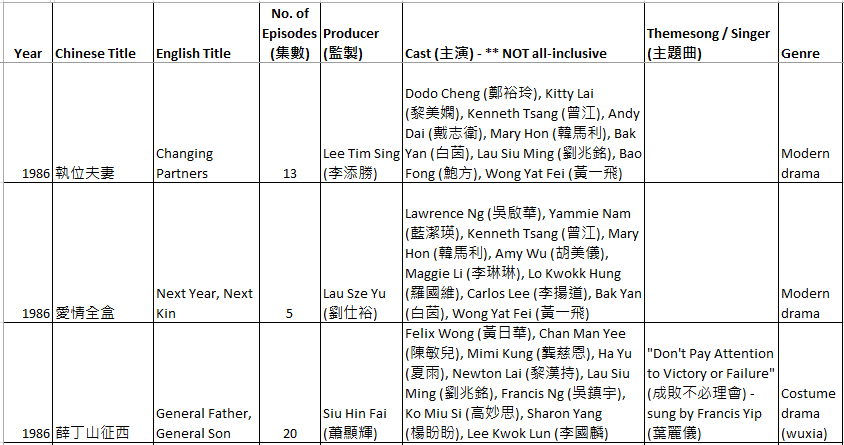
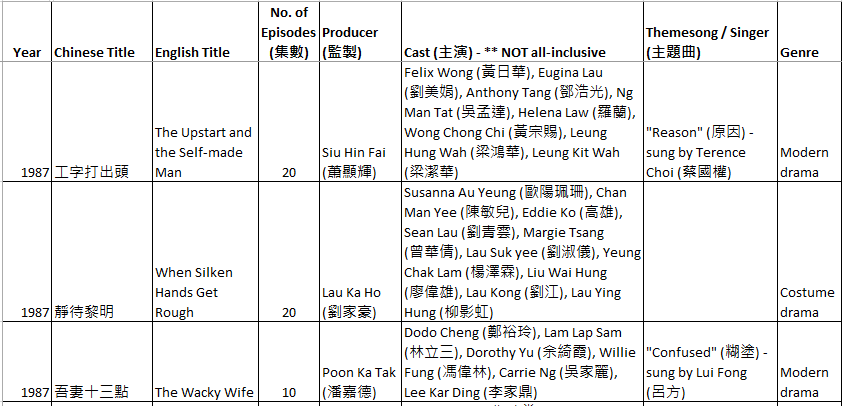
This is part 4 in a multi-part series of posts about TVB
series from the 80s era that I recommend. Please read this Introductory
post for details about how this came about: TVB
series recommendations from the years 1980 and 1981.
** Note: I
used Wikipedia in conjunction with TVB’s website and a few other sources to
gather the information for each series. Note that the cast lists are not
all-inclusive and the English song titles are rough translations.**
Here’s my list of recommendations from 1986 and 1987 (remaining years to follow in subsequent posts):
This
is part 3 in a multi-part series of posts about TVB series from the 80s era
that I recommend. Please read this Introductory post for details about
how this came about: TVB series recommendations from the years 1980 and 1981.
Here’s my list of recommendations from 1984 and 1985 (remaining years to follow in subsequent posts):
HKTV's second to last in-house produced series Night Shift will premiere on Wednesday (8/19). I've actually been looking forward to this series ever since I read about the filming of it 2 years ago! It's been a long wait, but based on everything that I've read as well as the trailer clips and other behind the scenes clips, I feel that this series will be a worthwhile watch. Of course, the sad part is that this also means we are one series closer to 'the end' of HKTV (though to be honest, it pisses me off more than saddens me, but I'll save that rant for another post). The below article came out today from Mingpao in anticipation of Night Shift's premiere -- it's a nicely written article / short interview of the creative minds behind the series: Jimmy Luk and Alex Pau (yes, that's the same team that produced To Be or Not To Be, which is one of my favorite HKTV series so far). I've also included a link to the 'documentary clip' that the writer mentioned in the article -- I actually saw the clip on HKTV's Facebook a couple days ago and posted it up on AF....here's the 'blurb' I wrote about it (paraphrase of what HKTV put on their FB post): As a prelude to next week's premiere, HKTV posted the following clip on their Facebook page. This is a special "documentary" clip that one of the professors and her student at Chinese University in HK put together documenting the last 2 weeks of filming Night Shift. According to the post, when the government made the announcement denying HKTV a license back in October 2013, Night Shift was in the middle of filming and was only 70% completed. Even after the announcement, the production team decided to finish filming anyway and this clip not only bears witness to how everyone felt at that time, it also shows the unity of the team and how much fire and passion they still had despite the imminent disbanding of the team....
The article is relatively short compared to MP's other interviews, but still a good article nonetheless. Enjoy!
Sincere. For
HKTV, that’s not a word that merely gets spoken – rather, they put that word
into action through their productions. A
television series produced with ‘sincerity’ is one that will definitely be felt
by discerning audiences.
As the second to last of HKTV’s series to air, the ‘sincerity’
of the series Night Shift (夜班) can already be felt
even prior to its broadcast. In October
2013, when the government’s decision to deny HKTV a license came down, Night
Shift was still in the middle of filming – faced with the possibility
that the series might never see the light of day, plus most of the production
team members were on the list of employees to be laid off the next day, the
group collectively decided that they still wanted to finish filming the
series. Tomorrow (8/19), two years after
it finished filming, Night Shift will finally get to face
audiences.
Earlier, there was a short 7-minute clip posted on the
Internet that documented the series’ last 2 weeks of filming. Watching the clip, the part that moved viewers
the most was when Alan Luk (陸駿光) expressed during an
interview segment that he felt the cast and crew of this series were like the
orchestral band in the movie Titanic – even during the last
moments of the ship sinking, they insisted on finishing their very last
performance. For those who participated
in the series, this was not merely a ‘project’ that they finish and move on to
the next one -- rather, for everyone involved this was a ‘work of art’ in which
they invested a lot of blood, sweat, and tears.
Three main story
arcs
Interviewed for this article, Night Shift’s chief
director Jimmy Luk (陸天華) and script supervisor
Alex Pau (鮑偉聰) revealed that the concept for the
series actually came from American TV series Third Watch, a story
about people who worked at night. The 3
main story arcs revolve around the West Kowloon district’s E.U. team (衝鋒隊)
headed by Frankie Lam (林文龍), the underworld triad
led by Philip Keung (姜皓文), and a group of young
women, led by Kathy Yuen (湯怡), who frequent seedy
night arenas in the hopes of making a quick buck. Within these 3 main arcs, there are many sub-story
arcs that involve a vendor selling fruit at his stand, a vegetable street
market, a trash collector, an ambulance, and even a ridiculous murder case that
occurs at a midnight fair. Jimmy Luk
expressed: “Each sub-story arc will take
up anywhere from ½ to 1 episode and will be interwoven throughout the 3 main
story arcs. Because of this, audiences
may feel that the plot is bit ‘scattered’, as the story will jump from one occupation
to another – this is actually done on purpose, as the main focus is really on ‘night-time’. Things that people may not be willing to say
or do during the day, all is let loose at night, people’s true sentiments are
revealed, and the dark side of society is brought out.”
Laid off workers
continue to participate in the series
Helmed by the same production team as HKTV’s earlier hit
series To Be or Not To Be (來生不做香港人), Night
Shift marks the second collaboration between director Jimmy Luk and
scriptwriter Alex Pau. Recounting that
fateful day in October 2013 when the government’s decision to deny HKTV a
free-to-air TV license came down, Jimmy Luk revealed that his boss Ricky Wong (王維基)
called him to his office and told him that he was planning on laying off 200
people the very next day. Given the
circumstances, Jimmy was asked whether he wanted to continue filming the series. As someone who believed in finishing what was
started, plus so many people had put their hearts and souls into the
production, Jimmy did not hesitate in telling Ricky Wong that he wanted to
continue filming the series -- with that, all of the workers who were already
laid off immediately returned on a ‘free-lance’ basis to finish the production.
The rare chance to work together again and
the determination to ‘finish what they started’ united the team together –
morale was especially high and the ‘fire’ in their hearts burned stronger ever. Jimmy expressed that working for HKTV was the
most enjoyable experience of his career, as he got the chance to feel what it
meant to truly have ‘complete creative freedom’, which is a concept virtually unheard
of in the HK television industry. Without
hesitation, Jimmy stated, “If one day Ricky Wong is issued a license and he
asks me to go back and work for him, I would do it in a heartbeat!”
With Night Shift being scriptwriter Alex
Pau’s very last collaboration with HKTV, he states that instead of feeling sad
at having to leave the company, he decided to approach it with a heart of
gratitude that he got the chance to explore different genres and filming methods
at HKTV. “The concept for Night
Shift came about after Ricky Wong declared that he wanted to take an ‘American
series approach’ with all of his productions.
This entirely ‘new’ style of filming was rare in the HK television
industry and through it, we hoped to show audiences that it IS possible for HK
production teams to film series this way.
Actually, I need to specially thank director Jimmy Luk – at that time,
Ricky Wong was very ambitious and upped the ante by having all the script
supervisors ‘sell’ their story concepts to the group and gave the chief
directors complete authority on whether they liked the stories enough to film. Some of the story concepts were actually rejected
by the directors, so you can imagine the pressure that us script supervisors
felt. During that presentation, when I
brought up the premise for Night Shift, Jimmy Luk was the first
one to raise his hand and say ‘I really want to film that!’ To this day, I am still extremely grateful
for his recognition!”
Filmed entirely at
night, no ‘main leads’ in the series
Alex Pau further expressed, “I would also like to thank
the artists who participated in the series – it was hard enough that they all
had to re-arrange their schedules for a month to film entirely at night, they
also had to deal with a neurotic script supervisor such as myself! This series is unique in that everyone’s screen
time is scattered and uneven and the main story line is fuzzy – to be honest,
none of the artists in the series can be considered ‘leads’. This is an entirely new format and also a
different way of storytelling that left the artists a bit perplexed when
filming, but they persevered anyway.
Lastly, I would like to thank the entire production team for selflessly giving
so much of their time and effort to help me fulfill this crazy story concept!”
This is part 2 in a multi-part series of posts about TVB series from the 80s era that I recommend. Please read this Introductory post for details about how this came about: TVB series recommendations from the years 1980 and 1981.
** Note: I
used Wikipedia in conjunction with TVB’s website and a few other sources to
gather the information for each series. Note that the cast lists are not
all-inclusive and the English song titles are rough translations.**
Here’s my list of recommendations from 1982 and 1983 (remaining years to follow in subsequent posts):
Recently, there has been a lot of talk about ‘the good
old days’ of TVB and the ‘golden era’ of the HK television industry (which in
my opinion is represented by the early 80s to mid-90s, though officially that
era includes the late 70s as well as the late 90s). Since I grew up in the 80s era surrounded by
TVB series (our entire household consisted of TVB fans back then), it’s
probably not surprising that I’ve seen so many of the series from that
era. Some of the series I watched back in the 80s
when I was too young to understand what the series were about, whereas others I
watched (or re-watched in some cases) later on when I was older. Regardless of when I watched though, the TV
series from those days (80s and 90s) will always be TVB’s best productions in
my book. Yes, of course there were
‘good’ series as well as ‘bad’ series back then, as that is inevitable no
matter which era – the difference is that the ratio of ‘good’ series to ‘bad’
series back then was way higher than it is now (the ‘rough estimate example’ I
always use is that back in those days, I would venture to say that at least half or more of the series released in a year were 'good' and/or worth watching from beginning to end, while nowadays, I would be hard-pressed to find even a handful that I would consider ‘good’ or that I'm able to tolerate enough to sit through from beginning to end -- THAT’s how bad it’s gotten!)
We all know that TVB’s series have gone downhill the past
decade or so (actually longer than that depending on who you ask – my personal
opinion is that their series have been going downhill for the past 15
years). Well, with TVB’s series hitting
an ‘all-time low’ in the past 2 to 3 years, there has been an increased
interest on the part of many audiences to watch/re-watch the older TVB classics
from the 80s/90s era. Unfortunately,
many of the series from those eras (especially the 80s era) are very hard to
find nowadays, as technology was not as advanced back then (there was none of
this ‘streaming on the internet’ stuff that we have now) and TVB has been very
‘stingy’ about releasing many of the older classics on DVD over the years. Nowadays, pretty much the only way to watch
these older classics is to wait for TVB to re-broadcast those series on their
TV channels (i.e. during midnight timeslot) or, if you live in Hong Kong, you
can go on TVB’s website to watch (TVB launched their GOTV service about 2 years
ago where, if you have a paid subscription, you can have access to their entire
‘vault’ of series produced from the 1970s to now, so fans can re-watch to their
heart’s content…but again, the caveat is that this service is limited to HK
region ONLY).
Since I’ve been asked several times over the years for
recommendations of TVB series to watch from those eras, I decided to finally
compile the lists and post on my blog (80s era only for now). For the record, these lists only consist of
series that I’ve watched and therefore are absolutely NOT all-inclusive. Also, another ‘disclaimer’ of sorts: just because certain series are on the list, doesn't mean they are 'good' series nor are they necessarily my favorites -- some of the series I included because I may feel that they are worth a watch purely from
a ‘historical’ (TVB history) perspective, regardless of whether I personally liked the series or not.
Some of the series may sound familiar, as most of the popular classics from
that era are included, as are some of the more obscure works that some
audiences may never have heard of.
Lastly, I didn’t have time to include plot synopsis of each series, so I would recommend Googling for that information if needed. I also didn’t put down any comments or notes about why I recommend the
series or what my thoughts are/were on each series (mostly because I don’t have
time for that but also in some cases, I don’t remember enough about the series
to give any type of detailed analysis).
With that said however, I don’t mind giving brief thoughts on particular
series or helping with questions/research on certain individual ones if asked –
I just didn't have time to do that on all of them for this post.
** Note: I used Wikipedia in conjunction with TVB’s
website and a few other sources to gather the information for each series. Note that the cast lists are not
all-inclusive and the English song titles are rough translations.**
Here’s my list of recommendations from 1980 and 1981
(remaining years to follow in subsequent posts):
I’m currently watching HKTV’s medical drama Hidden Faces. Unlike traditional HK medical dramas, this one from HKTV is a very sincere, slice-of-life portrayal of ordinary events that occur at a franchised medical clinic. The 3 main doctors in the series are played by John Chiang (family medicine), Frankie Lam (plastic surgery), and Wilson Tsui (Obstetrics/Gynecology) – all 3 characters have markedly different personalities and both good as well as not-so-good sides to them (in other words, they are very much flawed, which makes them all the more realistic). I don’t want to comment too much on the series, since I haven’t finished watching it yet – but one thing I will say is that I’m 12 episodes into the series (episode 13 airs today) and am enjoying it immensely! Sure, the series is not fast-paced and action-packed like The Menu was and because of that I’m sure the series won’t generate the same type of hype and attention that series did (with that said though, recent media reports claim that HKTV’s ‘ratings’ slumped drastically after The Menu but now with the airing of Hidden Faces, the ‘ratings’ have gone back up, albeit not to the level it did when The Menu aired)….but I’m ok with this because to be honest, I wasn’t expecting a lot of action given the genre of the series. From what I’ve seen so far, I feel that Hidden Faces is more along the lines of To Be or Not to Be (minus the controversial societal/political theme) – it’s a slow-paced but meaningful series that doesn’t take sides (one of the things I loved about TBONTB)….instead, it leads audiences to self-reflect and ponder various aspects of life and through that, arrive at our own conclusions about right and wrong, moral and immoral. (In other words, the series ‘tells it like it is’ and, as an audience, you get what means the most to you from it, which will likely be different from the next person).
Anyway, I digress….the purpose of this post is actually to share one of the ‘articles’ that Ricky Wong wrote as part of his daily column for HK newspaper Sky Post. For this past Thursday’s column, he decided to write about Hidden Faces -- after reading his editorial, I feel it is a good supplemental read for those of us chasing the series (though I also recommend checking out HKTV’s Facebook page as well, since they usually post up quite a bit of ‘inside’ info about the series that are currently airing). The first part of the article about the significance of the series’ Chinese title was actually already explained on Facebook last week – Ricky Wong basically extends the explanation further with his post and correlates it to his thoughts on life. It’s a very brief but interesting read….
The other day, a netizen left a message on HKTV’s Facebook page asking about the significance of the ‘three faces’ (三面) in the series Hidden Face’s (三面形醫) Chinese title. The scriptwriter responded with the explanation that the ‘three faces’ refers to each person having 3 different sides (faces) to them from a mental/psychological perspective. The first side (face) is ‘one’s true self’ – raw, unassuming, not influenced by outside forces, it’s who you truly are deep inside. The second side (face) is ‘how other people see oneself’ – basically, it’s how other people view you based on various factors. The third side (face) is ‘the self that exists for others’ – the side that we cover up, pretend, change for other people’s sake.
After enduring so many setbacks in life, I now have a better understanding of what it means to ‘take things in stride’ – by experiencing and learning, I am slowly starting to grasp its significance and realize how important it is to have a heart of gratitude. In the series, there is a line of dialogue that goes like this: “What you possess today, others may never be able to possess in their entire lifetimes. If you’re still not satisfied [with all you already have], there is no surgery in the world that can help you.” The characters in the series think that going through plastic surgery will help them gain even more in life, forgetting that they should actually be happy with what they already have. This is how it works in real life as well: you may feel that your life currently is not as good as someone else’s, but in reality, it is already better than what many people experience in their entire lifetimes. Since that’s the case, why spend so much of your time ‘existing’ for others and chasing after other people’s ideals? If you continue to spend your life blindly pursuing others, you will only lose your way in the end.